Skip to content
Learning Site
Home

About

  • About Robotical
  • Case Studies
  • Meet the Team
  • Blog
  • Contact Us

Our Products

  • Marty the Robot
  • Axiom
  • Cog

Teach

  • Lessons & Resources
  • Marty for Educators
  • Funding & Grants
  • Professional Development
  • Why Teach STEM?
  • Coding Environments
  • Student Led Learning

Let's Code

  • Marty the Robot
  • Code Online
  • Marty Apple App
  • Marty Android App
  • Update your Marty
  • Cog
  • Code Online
  • Cog iOS App
  • Cog Android App
  • Axiom
  • Axiom Science

Support

  • Marty Get Started
  • Cog Quick Start Guide
  • Axiom Science Quick Start Guide
  • Support & FAQs
  • Marty V2 User Guides
  • Marty V1 Resources
  • Request Support
  • Request Top-Up Training

Shop

  • Marty the Robot and Physical Computing
  • Class Packs
  • Add Ons & Extras
  • Account
  • Shipping, Returns & Cancellations
  • Distributors
HomeLessonsUnits of workCurriculum standardsTutorials

Information

  • Lessons & Resources
  • Knowledge Base & User Guides
  • About Us
  • Shipping, Returns & Cancellation
  • Privacy Policy
  • Learning site privacy
  • Terms of Service
  • Partner Hub

Support & Help

  • Support & Help Center
  • Getting Started with Marty V2
  • Getting Started with Marty V1

Learning, Resources & Guides

  • Marty V2 Lessons Site
  • Marty V1 Lessons Site

Contact Us in the UK

Stanhope House,12 Stanhope Place,Edinburgh,United Kingdom,EH12 5HH
(+44) 0131 564 0922
hello@robotical.io
Contact Us

Contact Us in the US

2810N Church St, PMB 61694,Wilmington,Delaware,USA19802-4447
(+1) 833 886 1661
hello@robotical.io
Contact Us

Why not join our mailing list?

For News, New Products and Special Offers

Join mailing list

Copyright 2016-2026 © Robotical Ltd

All lessons
Marty app
CurrentPrevious

English Language Arts - Lower Years - Lesson 1 - Tell Me What Happened

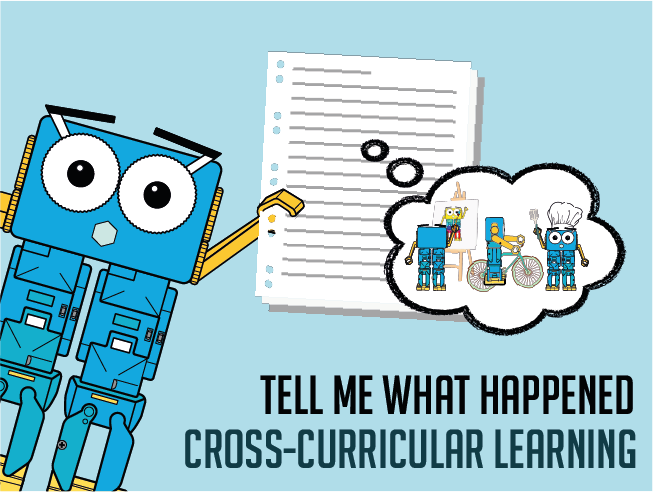
Use Marty as a report stimulus so that learners can begin to properly sequence witnessed events.
English Language Arts - Lower Years - Lesson 1 - Tell Me What Happened
Estimated time
30 minutes
Difficulty
Intermediate
Products
Marty V2

On this page

  1. Lesson overview
  2. Objectives & resources
  3. Key vocabulary
  4. Lesson plan
  5. Extensions and challenges
  6. Additional reading
  7. Curriculum standards

Extensions and challenges

Extend

Have learners create a multi-media text: written, drawings and spoken. Then, they could share this with visitors to the classroom or to their peers.

Support

There is a document with a word bank in the resources section to support learners with their writing. The alternative is to have learners record an audio text or have an adult scribe to support their text creation.

Additional reading

Using MartyBlocks

Curriculum standards

18
Choose your curriculum to see the relevant standards.

18 of 18 linked standards shown.

Common CoreUSA6
Curriculum areaLinked standards
English Language Arts: Language
English Language Arts: Speaking & Listening
English Language Arts: Writing

Select a code to read the full standard.

English Language Arts: Language

  • L.K.1Demonstrate command of the conventions of standard English grammar and usage when writing or speaking.
  • L.K.2Demonstrate command of the conventions of standard English capitalization, punctuation, and spelling when writing.

English Language Arts: Speaking & Listening

  • SL.K.3Ask and answer questions in order to seek help, get information, or clarify something that is not understood.
  • SL.K.5Add drawings or other visual displays to descriptions as desired to provide additional detail.

English Language Arts: Writing

  • W.K.3Use a combination of drawing, dictating, and writing to compose informative/explanatory texts in which they name what they are writing about and supply some information about the topic.
  • W.K.8With guidance and support from adults, recall information from experiences or gather information from provided sources to answer a question.
Curriculum for ExcellenceScotland6
Curriculum areaLinked standards
Health and Wellbeing: Mental, Emotional, Social and Physical Wellbeing
Literacy & English: Listening and Talking
Literacy & English: Writing

Select a code to read the full standard.

Health and Wellbeing: Mental, Emotional, Social and Physical Wellbeing

  • HWB 0-11a / HWB 1-11a / HWB 2-11a / HWB 3-11a / HWB 4-11Social wellbeing
  • HWB 0-14a / HWB 1-14a / HWB 2-14a / HWB 3-14a / HWB 4-14aSocial wellbeing

Literacy & English: Listening and Talking

  • LIT 0-04aFinding and using information
  • LIT 0-10aCreating texts

Literacy & English: Writing

  • LIT 0-26aOrganising and using information
  • LIT 0-09b / LIT 0-31aCreating texts
Georgia Standards of ExcellenceUSA6
Curriculum areaLinked standards
Computer Science:
English Language Arts: Speaking and Listening
English Language Arts: Writing

Select a code to read the full standard.

Computer Science:

  • CSS.EL.K-2.1Recognize that technology provides the opportunity to enhance relevance, increase confidence, offer authentic choice, and produce positive impacts in learning.
  • CSS.DA.K-2.9Understand how people can use technology.

English Language Arts: Speaking and Listening

  • ELAGSEKSL2Confirm understanding of written texts read aloud or information presented orally or through media by asking and answering questions about key details and requesting clarification if something is not understood.
  • ELAGSEKSL5Add drawings or other visual displays to descriptions as desired to provide additional detail.

English Language Arts: Writing

  • ELAGSEKW2Use a combination of drawing, dictating, and writing to compose informative/explanatory texts in which they name what they are writing about and supply some information about the topic.
  • ELAGSEKW5With guidance and support from adults, respond to questions and suggestions from peers and add details to strengthen writing as needed.

Resources

Learner resources

  • Tell Me What Happened - Word BankFile links loading
  • Workbook for Tell Me What HappenedFile links loading

Educator resources

  • Teacher guideFile links loading
  • Presentation for Tell Me What HappenedFile links loading
  • Suggested Mime MovementsFile links loading

Lesson overview

Watch as Marty carries out a sequence and help learners to retell the event with simple sentences and the opportunity to support with illustrations.

Cross-curricular links

English Language Arts - recounting an event

Learning objectives

  • I can retell an event in the correct order.

Resources and equipment

  • Activity pages
  • Marty the Robot V2
  • A device with MartyBlocks to prepare the code for the programs that learners will retell

Key vocabulary

  • first
  • next
  • then
  • after
  • other sequence words

Lesson plan

Pre-Lesson Preparation

There are several mini-programs in the teacher guide, which are quick to build. The best idea would be to build them all and save each with a memorable name, like, 'Tell me what happened (number)' where number is the program number in the resources.

Have one of more ready for learners to watch and later recount orally, pictorially, in written form or a combination of these. These programs will be used in the get learning and time for practice sections.

Warm-Up

Share with learners the objectives and success criteria for the day's lesson, from slide 2 of the presentation in the resource section; perhaps display this before the lesson starts and keep it displayed until another slide is needed.

Tell learners that they are going to play a game where they will need to pay careful attention to what they see so they can tell others about it.

Below are the procedure for the game. There is a list of possible charade-type actions in the resources section for you to use if you need some ideas.

1. Give mime-actions to each learner to perform, either whisper to each learner or share a small note for them to read.

2. Learners will take the information you share with them and act out the action.

3. One learner in the class will watch what they have done and will need to describe the sequence of movements that the actor performed.

4. The other learners will either look away or close their eyes.

5. The learner that was watching needs to describe the movement to the others and the listeners need to think about what the action could be.

6. You could choose to either have listeners guess the action or try to reproduce it based on the description.

7. Have the actor repeat the movement or say what it was they were miming.

8. Pick a new learner until everyone who is able has had a turn to be an actor and everyone that can has had a chance to describe the sequence of actions.

The goal is to have learners get used to saying what they saw in a ordered sequence.

Get Learning

Present Marty to the class and have the first program ready for them to perform. Tell learners they need to watch carefully to see what movements Marty performs. Tell them that they will need to say what they saw after Marty stops.

Slide 3 shows the video for the first program if you are not able to prepare the program in MartyBlocks; delete this slide if you have prepared the program. Slide 4 shows three actions from the first program. Follow the notes on the slide for this part of the lesson.

Slide 5 shows the video for the second program if you are not able to prepare the program in MartyBlocks; delete this slide if you have prepared the program. Slide 6 shows three actions from the second program. Follow the notes on the slide for this part of the lesson.

Take time to talk through the actions. Model ordering the words to properly describe the program. The other programs will be explored with small groups or as a whole class but will not have the support of the presentation.

Time for Practice

For this part of the lesson, you could either have learners in groups, each with a device to work on for their Marty and a text to write, or you could have one Marty for the whole class with learners writing in their groups to share what they see Marty do. Consult the resources section for the programs.

Click here to see all the program in a YouTube playlist.

Cool Down

Bring learners back together to discuss how feel they feel they did with the descriptions.

Suggested questions you might ask:

  • Who was able to say what Marty did?
  • Who used writing, speaking or drawings to describe what Marty did?

If you use a formative assessment strategy, like thumbs up or thumbs down, use that here to get a feel for learner confidence with the topic.

Carry out any end of lesson routines.