Skip to content
Learning Site
Home

About

  • About Robotical
  • Case Studies
  • Meet the Team
  • Blog
  • Contact Us

Our Products

  • Marty the Robot
  • Axiom
  • Cog

Teach

  • Lessons & Resources
  • Marty for Educators
  • Funding & Grants
  • Professional Development
  • Why Teach STEM?
  • Coding Environments
  • Student Led Learning

Let's Code

  • Marty the Robot
  • Code Online
  • Marty Apple App
  • Marty Android App
  • Update your Marty
  • Cog
  • Code Online
  • Cog iOS App
  • Cog Android App
  • Axiom
  • Axiom Science

Support

  • Marty Get Started
  • Cog Quick Start Guide
  • Axiom Science Quick Start Guide
  • Support & FAQs
  • Marty V2 User Guides
  • Marty V1 Resources
  • Request Support
  • Request Top-Up Training

Shop

  • Marty the Robot and Physical Computing
  • Class Packs
  • Add Ons & Extras
  • Account
  • Shipping, Returns & Cancellations
  • Distributors
HomeLessonsUnits of workCurriculum standardsTutorials

Information

  • Lessons & Resources
  • Knowledge Base & User Guides
  • About Us
  • Shipping, Returns & Cancellation
  • Privacy Policy
  • Learning site privacy
  • Terms of Service
  • Partner Hub

Support & Help

  • Support & Help Center
  • Getting Started with Marty V2
  • Getting Started with Marty V1

Learning, Resources & Guides

  • Marty V2 Lessons Site
  • Marty V1 Lessons Site

Contact Us in the UK

Stanhope House,12 Stanhope Place,Edinburgh,United Kingdom,EH12 5HH
(+44) 0131 564 0922
hello@robotical.io
Contact Us

Contact Us in the US

2810N Church St, PMB 61694,Wilmington,Delaware,USA19802-4447
(+1) 833 886 1661
hello@robotical.io
Contact Us

Why not join our mailing list?

For News, New Products and Special Offers

Join mailing list

Copyright 2016-2026 © Robotical Ltd

All lessons
Marty app
CurrentPrevious

Thinking about and Investigating Risk with Marty

Develop skills in math by carrying out an experiment with Marty to explore the idea of chance and uncertainty
Thinking about and Investigating Risk with Marty
Estimated time
45 minutes
Difficulty
Intermediate
Products
Marty V2

On this page

  1. Lesson overview
  2. Objectives & resources
  3. Key vocabulary
  4. Lesson plan
  5. Extensions and challenges
  6. Additional reading
  7. Curriculum standards

Extensions and challenges

  1. Students could look up the probability of specific events happening such as winning a lottery and find out how probability is used to communicate information to help us e.g. flood warning and weather forecasts
  2. Students can repeat the experiment, changing the chance of a random left kick and share with their class how their findings differ from the first experiment.
  3. Students could calculate the average of their results or the class results.

Additional reading

  • How to get started with MartyBlocks
  • Educator FAQ
  • Marty the Robot V2 - Educators Guide

Curriculum standards

20
Choose your curriculum to see the relevant standards.

20 of 20 linked standards shown.

Australian CurriculumAustralia2
Curriculum areaLinked standards
Digital Technologies, Design & technologies: Digital Technologies

Select a code to read the full standard.

Digital Technologies, Design & technologies: Digital Technologies

  • ACTDIK014Examine the main components of common digital systems and how they may connect together to form networks to transmit data
  • ACTDIP019Design, modify and follow simple algorithms involving sequences of steps, branching, and iteration (repetition)
CSTA Education StandardsUSA2
Curriculum areaLinked standards
General standards

Select a code to read the full standard.

  • 1B-DA-06Organize and present collected data visually to highlight relationships and support a claim.
  • 1B-DA-07Use data to highlight or propose cause-and-effect relationships, predict outcomes, or communicate an idea.
Curriculum for ExcellenceScotland12
Curriculum areaLinked standards
Health and Wellbeing: Mental, Emotional, Social and Physical Wellbeing
Literacy & English: Listening and Talking
Literacy & English: Reading
Literacy & English: Writing
Numeracy: Number, Money and Measure
Technologies: Computing Science

Select a code to read the full standard.

Health and Wellbeing: Mental, Emotional, Social and Physical Wellbeing

  • HWB 0-11a / HWB 1-11a / HWB 2-11a / HWB 3-11a / HWB 4-11Social wellbeing
  • HWB 0-14a / HWB 1-14a / HWB 2-14a / HWB 3-14a / HWB 4-14aSocial wellbeing

Literacy & English: Listening and Talking

  • LIT 2-02aTools for listening and talking
  • LIT 2-07aUnderstanding, analysing and evaluating

Literacy & English: Reading

  • LIT 2-15aFinding and using information

Literacy & English: Writing

  • LIT 2-23aTools for writing
  • LIT 2-25aOrganising and using information

Numeracy: Number, Money and Measure

  • MNU 2-01aEstimation and rounding
  • MNU 2-03bNumber and number processes including addition, subtraction, multiplication, division and negative numbers
  • MNU 2-07bFractions, decimal fractions and percentages including ratio and proportion

Technologies: Computing Science

  • TCH 2-14bUnderstanding and analysing computing technology
  • TCH 2-15aDesigning, building and testing computing solutions
England's National CurriculumEngland2
Curriculum areaLinked standards
Computing, Design and Technology: Computing
Computing, Design and Technology: Design and Technology

Select a code to read the full standard.

Computing, Design and Technology: Computing

  • ✔️Understand what algorithms are; how they are implemented as programs on digital devices; and that programs execute by following precise and unambiguous instructions

Computing, Design and Technology: Design and Technology

  • ✔️Design purposeful, functional, appealing products for themselves and other users based on design criteria
ISTEUSA2
Curriculum areaLinked standards
International Society for Technology in Education (ISTE)

Select a code to read the full standard.

International Society for Technology in Education (ISTE)

  • 3bStudents evaluate the accuracy, perspective, credibility and relevance of information, media, data or other resources.
  • 4dStudents exhibit a tolerance for ambiguity, perseverance and the capacity to work with open-ended problems.

Resources

Learner resources

  • Extra Results Sheet for ExperimentFile links loading
  • Workbook for Thinking about and Investigating Risk with MartyFile links loading

Educator resources

  • Teacher GuideFile links loading
  • Presentation for Thinking about and Investigating Risk with MartyFile links loading

Solution resources

  • SolutionsFile links loading

Lesson overview

This is the second of five lessons that focus on literacy, numeracy and social and emotional learning in the context of THRIVING in challenging circumstances.

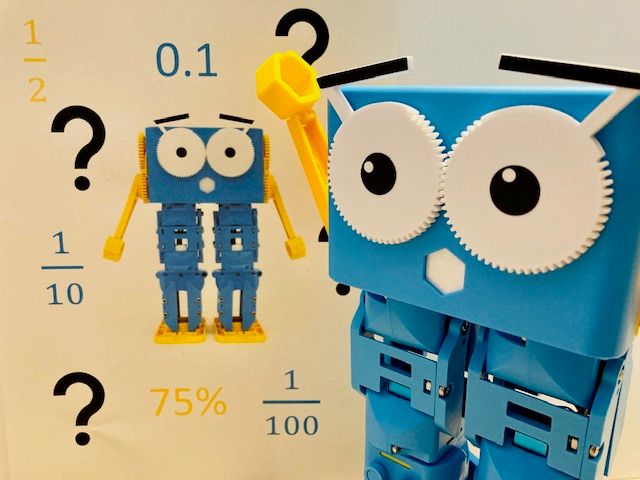
In this lesson, students will carry out an experiment into chance using Marty. Students will code Marty to make random movements and make predictions about outcomes. They will communicate their findings about probability displaying their results as simple fractions, decimal fractions and percentages.

Prerequisite knowledge

Awareness of basic probability and chance; experience with conditional statements

Cross-curricular links

Math - probability and conversions

Learning objectives

  1. Find out what a random code block does and use operator blocks to test if statements are true or false
  2. Use logic to code Marty in MartyBlocks to move in different ways if statements are true or false.
  3. Carry out a simple experiment into chance.
  4. Report probabilities using simple fractions, decimal fractions and percentages.
  5. Know that understanding the idea of risk can help us keep ourselves safe.

Resources and equipment

  • Coins and/or dice

Key vocabulary

  • Programming
  • Block coding
  • Logic (if, then)
  • Loop
  • Repeat
  • Chance, probability, risk
  • Random
  • Fraction, decimal, percentage

Lesson plan

  1. Either as a teacher demonstration or as a student activity, start by tossing coins and/or throwing dice asking students to guess what the outcome will be each time. Brainstorm scenarios when students might have come across making predictions in everyday life.
  2. Students need access to MartyBlocks to code Marty following the steps given in the Student Workbook.
  3. Students should start by exploring random blocks, looking to see if they can predict outcomes. Ask students to share their findings.
  4. Next students will test to see if statements are true or false before moving on to using logic to make Marty move in two different ways depending on whether the outcome is true or false. They will use this code as the basis for a simple experiment into chance and probability.
  5. By using Marty coded to randomly make a left kick or a right kick, students will carry out an experiment to count the number of left kicks and, from their results, report back on the probability of a left kick.
  6. Review conversion between simple fractions, decimal fractions and percentages and ask students to give their results in these equivalent forms and ask students to share the findings of their experiment.
  7. Discuss how we can assess the risk of an event happening from the number that describes the probability of it happening and explain how knowing about probability can help us make decisions to keep ourselves safe.