Help Marty see if we can organise the recycling

Support learners with estimating distances:
22 of 22 linked standards shown.
| Curriculum area | Linked standards |
|---|---|
| Digital Technologies, Design & technologies: Design & Technologies | |
| Digital Technologies, Design & technologies: Digital Technologies |
Select a code to read the full standard.
| Curriculum area | Linked standards |
|---|---|
| General standards |
Select a code to read the full standard.
| Curriculum area | Linked standards |
|---|---|
| Health and Wellbeing: Mental, Emotional, Social and Physical Wellbeing | |
| Literacy & English: Listening and Talking | |
| Literacy & English: Reading | |
| Literacy & English: Writing | |
| Numeracy: Number, Money and Measure | |
| Technologies: Computing Science | |
| Technologies: Technological Developments in Society and Business |
Select a code to read the full standard.
| Curriculum area | Linked standards |
|---|---|
| Computing, Design and Technology: Computing | |
| Computing, Design and Technology: Design and Technology |
Select a code to read the full standard.
| Curriculum area | Linked standards |
|---|---|
| International Society for Technology in Education (ISTE) |
Select a code to read the full standard.
This lesson is used to have learners investigate which 'type' of recyclable an item is.
Learners will organize objects for recycling into a variety of different categories: glass, plastic, paper, metal or non-recyclable.
Then learners will estimate movements for Marty and code a reaction for one, or more, of the recyclable types.
Basic recycling and litter symbols
Developments in Society and Business, Science
Share with learners the objectives and success criteria from the presentation.
Start by playing a game that involves sorting general classroom objects into categories, described or created by the learners: a variety of tools used for work like a ruler, scissors, crayons, pencils, etc; various items for an art lesson like a paint brush, water cup, clothing bib, paints, etc; a range of books like comic, magazine, fiction, class reader, non-fiction, dictionary, etc; coloured paper; construction toy pieces; etc.
Learners will, in their groups, organize the items they have into categories but they have to understand the categories they create and describe why one item belongs in a certain category.
Read the story that is in the presentation, with the images to support it. Following this, have learners complete the work page that asks them to put the describing words, or adjectives, with each item on the table; let learners know that it is possible to use an adjective more than once. You will notice that there is no row for non-recyclable items, feel free to ask learners why that row might not be there. The thinking was that all the adjectives could potentially be used to describe something that is not recyclable.
This is where learners need to sort the recyclable materials needed for this lesson. Once this is complete, line up the items against a wall, like the image below, mixing up the items so they are arranged in random order. If items were not gathered, images of recyclable items are a good substitute.
If you feel it would support, show learners the video below that shows items being organized into different categories, for recycling. It isn't necessary with the discussion during the presentation but could be a good support for some. Click on the 'Watch on YouTube' button at the bottom left of the video window to see it there.
Continue the presentation to see Marty inspecting several recyclable objects (the code is detailed in the teacher guide) and then share the starting code and video (on separate slides) for Marty to walk, and react, to one recyclable item (below). Learners will then engage with their groups to plan a sequence to get their Marty to walk, and react, to the recyclable item type that their group chose; so, stop the presentation after the second video of Marty reacting to the recycling. There are opportunities for learners to plan in their workbooks.
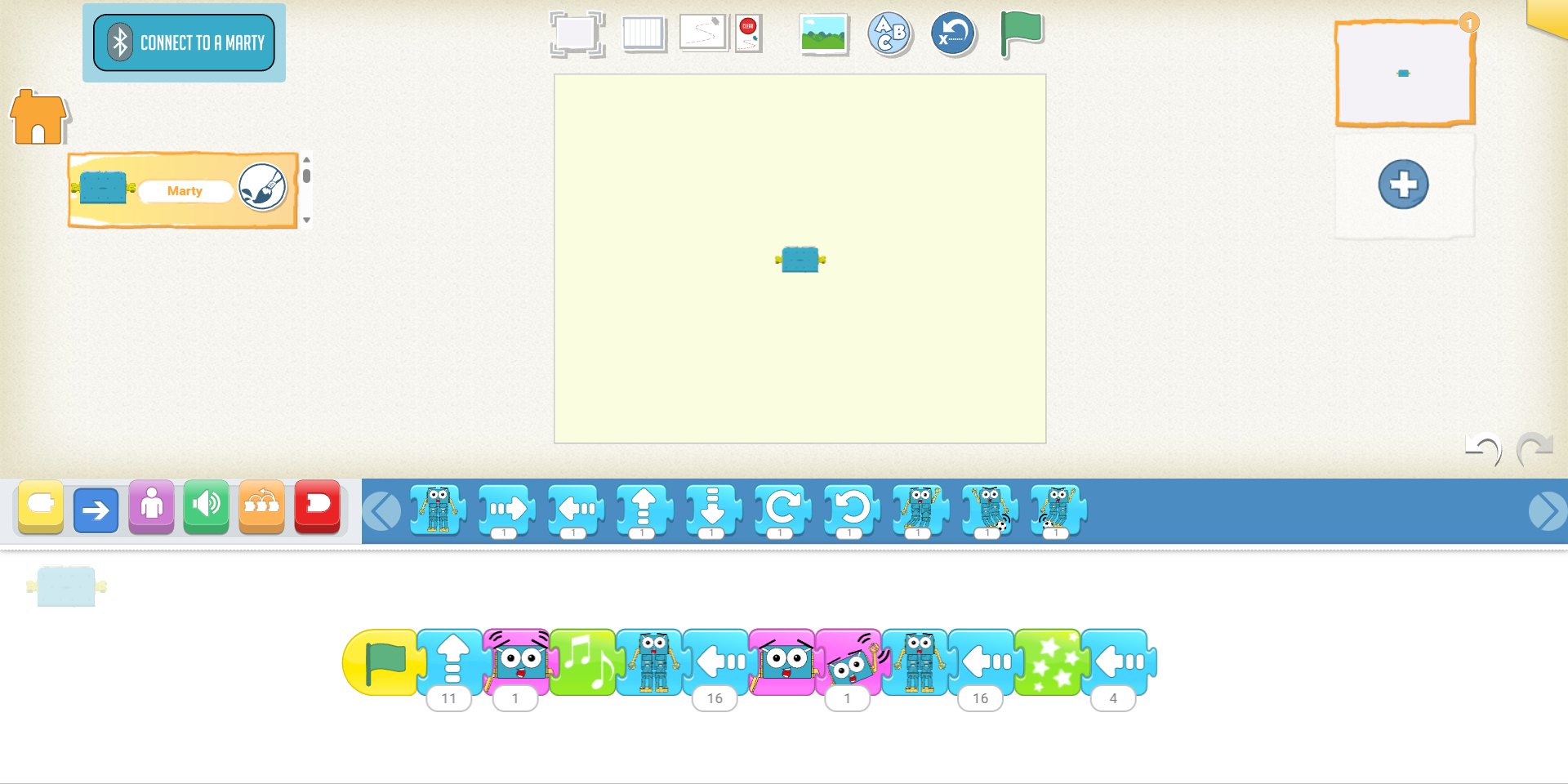
There will be plenty of time for trial and error at this point in the lesson: learners will need to do a lot of estimating and checking their work when it comes to having Marty accurately reach the first item and respond appropriately; learners will then need to estimate how many sidesteps it will take to reach the next item their group chose; this may need to be repeated with additional estimates. Feel free to share that the video in the presentation was not completed on the first estimate.
Strongly encourage that learners record their estimates on their planning page rather than just writing down the final attempt that was correct: it is worthwhile letting them see how they can quickly become more accurate with each estimate.
Celebrate the creative work that was accomplished: "You managed to get Marty to react to your group's recycling item. Fantastic work!"
Remind learners of the goals for the lesson, "Estimate distances with Marty; sort objects into different groups."
Ask learners if they think they did well with the lesson using a familiar formative assessment strategy: thumbs up for good, thumbs to the side for OK, thumbs down for not so good; a green, yellow or red card, indicating their thoughts; a one to one chat about the learning; whole class feedback using a PMI (plus, minus, interesting) approach; or some other strategy with which the learners are familiar. Ask them if there were any challenges they overcame or if there were any bugs they could not fix. Take time to discuss these
Read the closing part of the text to wrap up Marty's episode.
Carry out any end of lesson routines, and log off the devices.