Determine Fractional Measurements using a Number Line
12 of 12 linked standards shown.
| Curriculum area | Linked standards |
|---|---|
| Mathematics: Number and Algebra - Fractions and decimals |
Select a code to read the full standard.
| Curriculum area | Linked standards |
|---|---|
| Mathematics: |
Select a code to read the full standard.
| Curriculum area | Linked standards |
|---|---|
| General standards |
Select a code to read the full standard.
| Curriculum area | Linked standards |
|---|---|
| Health and Wellbeing: Mental, Emotional, Social and Physical Wellbeing | |
| Literacy & English: Listening and Talking | |
| Numeracy: Number, Money and Measure |
Select a code to read the full standard.
| Curriculum area | Linked standards |
|---|---|
| Mathematics KS2: Number - fractions |
Select a code to read the full standard.
| Curriculum area | Linked standards |
|---|---|
| Elementary Math: Knowledge and Skills |
Select a code to read the full standard.
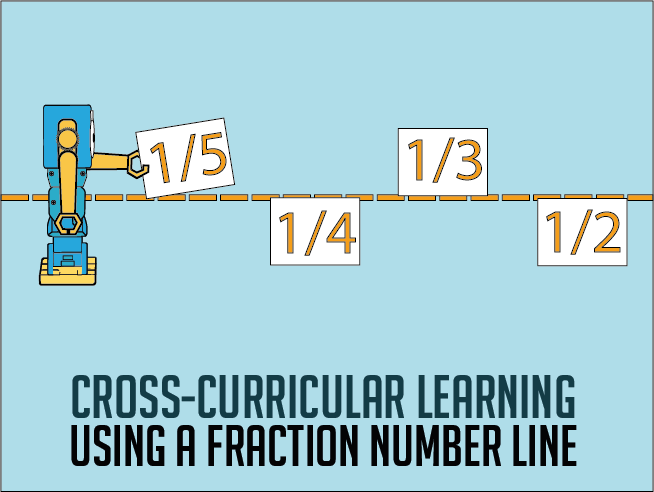
This lesson is about comparing fractions within the same whole. How far is 1/2 from 1/3? Use Marty to quickly illustrate the difference between fractions of a whole then use Marty to compare fractions with different wholes.
Fractions of a whole
Mathematics - Fractions
Open the Marty the Robot app and build the following piece of code into the workspace:
This code will have Marty walk a set distance and then walk a fraction of the first distance. You need to enter the values manually for how many steps, the initial step length and the first fraction before running the code.
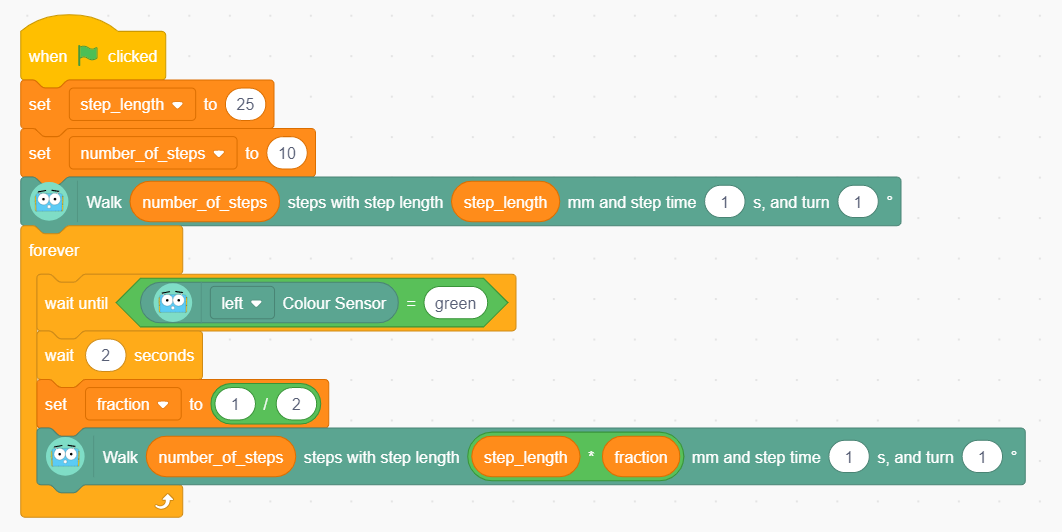
Save this code in the app and give it an appropriate name. Please consult the teacher guide for step-by-step instructions for building it.
Challenge learners to create different lines - use a ruler to draw various line lengths - and identify where the fraction should lie on that line.
| Activity |
|---|
Warm-UpShare with learners the objectives and success criteria for the day's lesson, from slide 2 of the presentation in the educator resource section; perhaps display this before the lesson starts and keep it displayed until another slide is needed. Tell learners that they are going to play What Time is it Mr Wolf Below is the procedure for the game 1. One person is chosen to be 'the Wolf'. 2. Learners who are not the wolf call out, "What time is it, Mr Wolf?" The title can be changed: Mr need not be used. 3. The wolf calls out number from 1-12, followed by o'clock. 4. Learners count to the number as they step to the wolf. 5. This repeats until a learner either touches the wolf or the wolf shouts dinner time and tries to catch the children. If the catch one, they swap places. To tie into today's lesson, stop the game mid way through and ask learners, "Can anyone tell me if they think they are about half way to the wolf (or the learner's name)?" Repeat with, "Can anyone tell me if they think they are less than half way to the wolf?" or, "more than half way?" Do this a couple of times as the different rounds unfold. The goal is to remind learners about estimating, in this case half a distance. |
| Activity |
|---|
Get LearningHave learners remind you about the value of fractions. The might suggest that a half is more than a fourth/quarter or a fifth is less than a third; additionally, they may offer that it takes two halves to make a whole, or similar statements with other fraction quantities. Display slide 3 from the presentation, it shows a line with a 0 on the far left and a 1 on the far right. The notes at the bottom of the presentation will guide a discussion but the goal is to determine good estimates of where fractional values would sit between 0 and 1, on a number line. If you would prefer to have a number line on a chalk board or whiteboard, please do so. Draw attention to the fact that all of these fractions have a one for what is called the numerator - the number on the top of the fraction. The numerator tells me how many pieces of a fraction I have. The number on the bottom is the denominator - this tells me how many pieces I need to make a whole. Say, "For one half, I have one piece out of two that I need to make a whole; so, when I add a half more, I have two halves, which is the same as a whole. Let's look at the other fractions. This is what the number two halves looks like: 2/2." The presentation on slide 4 illustrates how unit fractions are used to build other proper fractions with the same denominator. There are some animations that extend the unit fractions to show what increasing the numerator does to the value of the fraction. Slide 5 shows a number line with a series of question marks. 0, 1/2 and 1 are marked on the number line to give learners a benchmark for comparing their estimates. Take plenty of time asking why learners think what they do about the estimates they give and how they go about deciding which fraction is more than another. The next value to be revealed is the biggest question if you want learners to make estimates about how much each question mark represents. |
Time for PracticePresent Marty to learners. Enter a value into the code that you prepared before the lesson for the number of steps, keep in mind that each step is about one inch so it would be good to have Marty walk at least 20 or so steps to better illustrate a fractional distance: having Marty take 5 steps will result in fractional distances that are very close in terms of value: 1/2 the distance would be about 6 cm / 2.5 in, 1/5 the distance would be about 2.5 cm / 1 in; 1/4 and 1/3 are very difficult to distinguish. Also include the fractional amount that Marty is to walk, we recommend entering 1/2 for the second time Marty walks and then other fractions suggested by learners to address thirds, quarters/fourths and fifths. After Marty walks the last fractional distance, ask learners, "What do you think will happen if I press to run this program again?" If the last press had been for 1/5, move the green card to the 1/5 mark and place Marty down there. Marty will walk another fifth but not the combined distance is 2/5, mark this beside Marty's stopping point. If you want, repeat this until Marty reaches 1. Below are suggestions for how to demonstrate Marty and for a video of the process of marking the floor indicating the distance traveled
Share with learners the practice activity in the workbook, in the resources section, which shows several straight lines with Marty indicating about 1/2, 1/3, 1/4, 1/5. Learners need to mark the number line with different fractional distances, as indicated for each of the questions. Some questions include 1/2, 1/3, 1/4 and 1/5; if learners feel that including each of the unit fractions would support the task, encourage them to do so. SupportEncourage learners to use a ruler to draw the 1/3, 1/4 and 1/5 lengths from the activity page onto a scrap piece of paper. Once they draw this, they could use the drawn line to support finding where multiples of that fraction could sit on the line. Encourage learners to rely on the support page less as they progress through the activity page. |
| Activity |
|---|
Cool DownBring learners back together to discuss if they found anything challenging about identifying how much a fraction is worth. Suggested questions you might ask:
Carry out any end of lesson routines. |