Skip to content
Learning Site
Home

About

  • About Robotical
  • Case Studies
  • Meet the Team
  • Blog
  • Contact Us

Our Products

  • Marty the Robot
  • Axiom
  • Cog

Teach

  • Lessons & Resources
  • Marty for Educators
  • Funding & Grants
  • Professional Development
  • Why Teach STEM?
  • Coding Environments
  • Student Led Learning

Let's Code

  • Marty the Robot
  • Code Online
  • Marty Apple App
  • Marty Android App
  • Update your Marty
  • Cog
  • Code Online
  • Cog iOS App
  • Cog Android App
  • Axiom
  • Axiom Science

Support

  • Marty Get Started
  • Cog Quick Start Guide
  • Axiom Science Quick Start Guide
  • Support & FAQs
  • Marty V2 User Guides
  • Marty V1 Resources
  • Request Support
  • Request Top-Up Training

Shop

  • Marty the Robot and Physical Computing
  • Class Packs
  • Add Ons & Extras
  • Account
  • Shipping, Returns & Cancellations
  • Distributors
HomeLessonsUnits of workCurriculum standardsTutorials

Information

  • Lessons & Resources
  • Knowledge Base & User Guides
  • About Us
  • Shipping, Returns & Cancellation
  • Privacy Policy
  • Learning site privacy
  • Terms of Service
  • Partner Hub

Support & Help

  • Support & Help Center
  • Getting Started with Marty V2
  • Getting Started with Marty V1

Learning, Resources & Guides

  • Marty V2 Lessons Site
  • Marty V1 Lessons Site

Contact Us in the UK

Stanhope House,12 Stanhope Place,Edinburgh,United Kingdom,EH12 5HH
(+44) 0131 564 0922
hello@robotical.io
Contact Us

Contact Us in the US

2810N Church St, PMB 61694,Wilmington,Delaware,USA19802-4447
(+1) 833 886 1661
hello@robotical.io
Contact Us

Why not join our mailing list?

For News, New Products and Special Offers

Join mailing list

Copyright 2016-2026 © Robotical Ltd

All lessons
Marty app
CurrentPrevious

Think Before you Walk! Safe Travel Skills

Develop numeracy skills by programming Marty to move in this cross-curricular social and emotional learning activity
Think Before you Walk! Safe Travel Skills
Estimated time
45 minutes
Difficulty
Beginner
Products
Marty V2

On this page

  1. Lesson overview
  2. Objectives & resources
  3. Key vocabulary
  4. Lesson plan
  5. Extensions and challenges
  6. Additional reading
  7. Curriculum standards

Extensions and challenges

  1. Students could make a start and finish line for Marty, estimate how long it would take Marty to travel that distance at a fast and slow walking speed, then measure the time taken using a stopwatch.
  2. Students could look up the typical speed of different modes of transport such as walking, bicycle, car, train, tram and plane and share their findings.

Additional reading

  • How to get started with MartyBlocks
  • Educator FAQ
  • Marty the Robot V2 - Educators Guide

Curriculum standards

21
Choose your curriculum to see the relevant standards.

21 of 21 linked standards shown.

Australian CurriculumAustralia2
Curriculum areaLinked standards
Digital Technologies, Design & technologies: Digital Technologies

Select a code to read the full standard.

Digital Technologies, Design & technologies: Digital Technologies

  • ACTDIP021Explain how student solutions and existing information systems are sustainable and meet current and future local community needs
  • ACTDIP022Plan, create and communicate ideas and information, including collaboratively online, applying agreed ethical, social and technical protocols
CSTA Education StandardsUSA3
Curriculum areaLinked standards
General standards

Select a code to read the full standard.

  • 1B-DA-07Use data to highlight or propose cause-and-effect relationships, predict outcomes, or communicate an idea.
  • 1B-AP-08Compare and refine multiple algorithms for the same task and determine which is the most appropriate.
  • 1B-AP-15Test and debug (identify and fix errors) a program or algorithm to ensure it runs as intended.
Curriculum for ExcellenceScotland12
Curriculum areaLinked standards
Health and Wellbeing: Mental, Emotional, Social and Physical Wellbeing
Literacy & English: Listening and Talking
Numeracy: Number, Money and Measure
Technologies: Computing Science

Select a code to read the full standard.

Health and Wellbeing: Mental, Emotional, Social and Physical Wellbeing

  • HWB 0-14a / HWB 1-14a / HWB 2-14a / HWB 3-14a / HWB 4-14aSocial wellbeing
  • HWB 0-16a / HWB 1-16a / HWB 2-16a / HWB 3-16a / HWB 4-16Physical wellbeing
  • HWB 0-18a / HWB 1-18a / HWB 2-18a / HWB 3-18a / HWB 4-18aPhysical wellbeing

Literacy & English: Listening and Talking

  • LIT 2-02aTools for listening and talking
  • LIT 2-05aFinding and using information
  • LIT 2-06aFinding and using information

Numeracy: Number, Money and Measure

  • MNU 2-02aNumber and number processes including addition, subtraction, multiplication, division and negative numbers
  • MNU 2-10bTime
  • MNU 2-10cTime
  • MNU 2-11bMeasurement

Technologies: Computing Science

  • TCH 2-13aUnderstanding the world through computational thinking
  • TCH 2-15aDesigning, building and testing computing solutions
England's National CurriculumEngland2
Curriculum areaLinked standards
Computing, Design and Technology: Computing
Computing, Design and Technology: Design and Technology

Select a code to read the full standard.

Computing, Design and Technology: Computing

  • ✔️Understand what algorithms are; how they are implemented as programs on digital devices; and that programs execute by following precise and unambiguous instructions

Computing, Design and Technology: Design and Technology

  • ✔️Design purposeful, functional, appealing products for themselves and other users based on design criteria
ISTEUSA2
Curriculum areaLinked standards
International Society for Technology in Education (ISTE)

Select a code to read the full standard.

International Society for Technology in Education (ISTE)

  • 3dStudents build knowledge by actively exploring real-world issues and problems, developing ideas and theories and pursuing answers and solutions.
  • 4cStudents develop, test and refine prototypes as part of a cyclical design process.

Resources

Learner resources

  • Workbook for Think Before you Walk! Safe Travel SkillsFile links loading

Educator resources

  • Teacher GuideFile links loading
  • Presentation for Think Before you Walk! Safe Travel SkillsFile links loading

Solution resources

  • Solutions lessonFile links loading

Lesson overview

This is the fifth of five lessons that focus on literacy, numeracy, and social and emotional learning in the context of THRIVING in challenging circumstances.

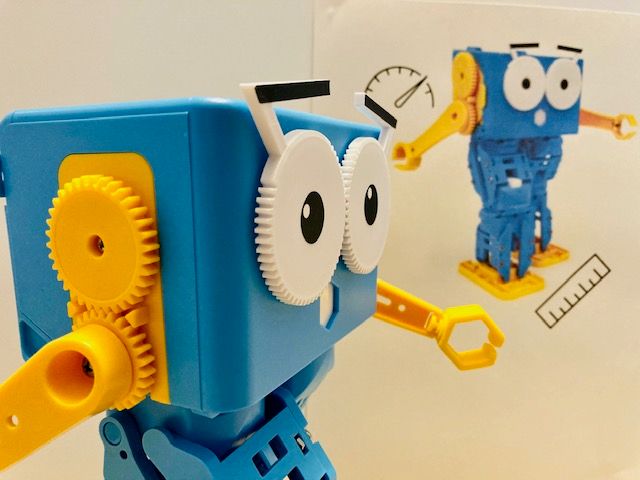
In this lesson, students will explore the effect of changing a digit, its place and its value on the time taken for Marty to complete a movement. To investigate the link between time, speed and distance. Students will then use MartyBlocks motion blocks to code Marty to move different speeds by varying Marty's step length and time. Students will copy Marty's movements to build safe travel skills.

Prerequisite knowledge

Knowledge of block parameters, loops and conditional statements

Cross-curricular links

Numeracy and Health and Wellbeing across learning

Learning objectives

  1. To explore the effect of changing a digit, its place and its value on the time taken for Marty to complete a movement and Marty's speed.
  2. Use MartyBlocks to carry out a practical task investigating the link between time, speed and distance coding Marty to move different speeds by varying step length and time.
  3. Copy Marty's movement to build safe travel skills.

Resources and equipment

  • How to get started with Marty Blocks
  • Educator FAQ
  • Marty the Robot V2 - Educators Guide

Key vocabulary

  • Programming
  • Block coding
  • Time
  • Length
  • Speed
  • Digit, place, value
  • Decimal fraction

Lesson plan

  1. Ask students to share how they travel to school and brainstorm the ways that they stay safe from traffic when they arrive outside school
  2. Students need access to MartyBlocks code to explore the effect of changing the time taken for Marty to complete two different movements by applying their knowledge of the terms digit, place and value.
  3. Ask students to code Marty to go for a short walk varying the length of Marty's steps to see the effects on travel speed.
  4. Students should apply their learning to work out how to make Marty travel faster and further by changing the numbers that control Marty's walking.
  5. Challenge students to copy Marty's walking movements to further explore how changing step length and time affect their own travel speed!